
Journal Is the Silicon Valley a myth of the past?
Is the Silicon Valley a myth of the past?
07 October 2013It may sound strange in today's globalized world, however... the Valley is still the essence of Innovation.
As part of a programme organized by the London Business School, I have recently had the opportunity to visit a few start-ups, and meet with Salim Ismail, Global Ambassador and Founding Executive Director at Singularity, and with Hector Garcia-Molina, Professor in the Departments of Computer Science and Electrical Engineering at Stanford University, and I can report I have been truly impressed by the vitality of these two Institutions.
Let’s start with the Stanford University.
The challenging academic programs are coupled with a beautiful campus, which can only generate a stimulating learning environment. The "climate" is surely playing a significant role, as you can feel the passion animating both Professors and students who could make it to such a demanding institution.
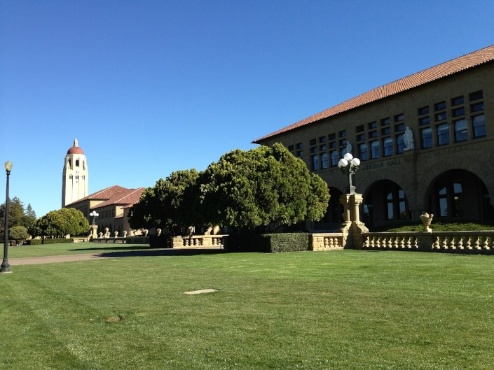

However, most importantly, the Silicon Valley’s well proven ecosystem is still making a huge difference.
Companies in the Silicon Valley are re-investing a large part of their profits into R&D or start-up initiatives, and there is a robust alliance in place between the large Enterprises, the start-ups and the University world.
The Universities are not only attracting and preparing the necessary talents, but also creating the background required to stimulate innovation: the students are actually invited to nurture their entrepreneurial vocations, which may also be funded by the University itself.
Also, the OTL or Office of Technology Licensing is made available.... directly at the Stanford University. "When Stanford intellectual property is the basis for a start-up company, Stanford’s goal is to maximize the chances of successfully transferring the technology while prioritizing the University’s missions of research and education. This obligation is the shared responsibility of OTL and the startup entrepreneurs, especially if they expect to maintain connections to the University (as faculty, staff or students) during the creation of the start-up or after it is launched. In the last several decades, over 6,000 companies were founded by members of the Stanford community. Most of these businesses, including Hewlett-Packard and Yahoo!, were started by Stanford faculty and students and did not use intellectual property owned by the University. Other start-up companies were formed to commercialize inventions that are subject to the intellectual property polices of Stanford University – founding technologies that were created with more than incidental use of Stanford resources or in the course of the inventors’ institutional responsibilities for research and education."
This is one of the elements which are working very properly, contributing to their virtuous circle of growth.
A few words about the Singularity University.... As it is stated on their website, the Singularity University utilizes accelerating technologies to address humanity’s hardest problems. They do this through a number of educational programs, and by driving "real-world solutions with their international network of exceptional faculty, alumni, corporate partners, mentors, investors & start-ups." Among their founders, Genentech, Google, Nokia and Cisco. Their aim is to stretch the best students’ capabilities by attacking very challenging problems so that they may truly invent and test innovative solutions.
I am still convinced that in tomorrow's highly competitive world, Large Corporations will remain the primary source of innovation, of course also by leveraging the power of the new technologies and crowdsourcing. Still, the virtuous circle created in Silicon Valley will continue allowing young entrepreneurs to take also part in this fascinating race.
Although the Silicon Valley remains a hard to replicate model, it is time to start seriously piloting similar initiatives, if Italy and Europe would like to participate as actors in the economy of the information age, where the technology is playing an ever more important role.


Leave a comment
Profile


After many years in the ICT business, I thought I'd seen 'em all. But I'm still learning... I'm trying to collect some ideas for a brand new digital agenda.
No comments